
You just finished nursing school, or you are about to, and now there is one more exam standing between you and your license. Maybe you are working shifts as a tech or new grad hire. Maybe you have kids, a commute or a second job. Maybe you already sat for the NCLEX once and it did not go your way.
Whatever your situation, the feeling is usually the same: there is too much content and not enough time, and you are not sure where to start. That is not a motivation problem. It is a planning problem, and planning problems can be solved.
Below is a realistic 8-week NCLEX study plan you can shrink or stretch, built around what the 2026 NCLEX-RN actually tests.
How Long Should an NCLEX Study Plan Be?
There is no official timeline, but many first-time candidates do well with a structured plan of roughly 6 to 8 weeks, studying around 2 to 4 focused hours a day, weighted toward the Client Needs categories that make up the largest share of the exam.
Here is why that range works. The NCLEX-RN gives you between 85 and 150 items in up to five hours, including breaks, and it adapts to your ability after every answer. That means you need broad content coverage plus a lot of practice making decisions under time pressure. Cramming for two weeks rarely builds both. Studying for six months often leads to burnout and forgetting what you learned early.
Timing also lines up with scheduling. Once you have your Authorization to Test, first-time candidates are offered an appointment 30 days after the request to schedule, and you can decline and choose a later date. Many grads start their plan before the ATT arrives, then book a date that lands at the end of their final week.
Build Your Plan Around the 2026 Test Plan
The most efficient plan mirrors the exam blueprint. The 2026 NCLEX-RN Test Plan, effective April 1, 2026 through March 31, 2029, assigns each Client Needs category a percentage of items. Individual exams may vary.
| Client Needs category | Share of items |
|---|---|
| Management of Care | 15 to 21% |
| Pharmacological and Parenteral Therapies | 13 to 19% |
| Physiological Adaptation | 11 to 17% |
| Safety and Infection Prevention and Control | 10 to 16% |
| Reduction of Risk Potential | 9 to 15% |
| Health Promotion and Maintenance | 6 to 12% |
| Psychosocial Integrity | 6 to 12% |
| Basic Care and Comfort | 6 to 12% |
Management of Care and pharmacology together account for 28 to 40% of items on the test plan. If those are weak spots, they deserve more than an even share of your calendar. For a deeper breakdown of each category, see our guide to the NCLEX test plan.
The 8-Week NCLEX Study Plan, Week by Week
Each week pairs content review with daily practice questions. Content tells you what is true; questions train you to decide what to do first.
Week 1: Baseline and Setup
- Take a mixed practice set to see where you stand. Do not panic about the score; you are collecting data.
- Work through the free NCLEX Tutorial and NCLEX Exam Preview so the item types feel familiar.
- Handle logistics: register with Pearson VUE, make sure the name on your registration matches your ID exactly, and watch for your ATT.
- Review fundamentals: vital signs, assessment basics, communication and documentation.
Week 2: Management of Care and Safety
- Prioritization frameworks, delegation and assignment, client rights, advocacy and informed consent.
- Infection prevention, transmission-based precautions, fall and restraint safety, error prevention.
- Daily mixed questions with a lean toward these two categories.
Week 3: Pharmacology
- Study by drug class, not drug by drug: key side effects, priority nursing actions and client teaching.
- High-alert medications such as anticoagulants, insulin, opioids and electrolytes like potassium.
- IV therapy, blood administration and transfusion reactions.
Week 4: Physiological Adaptation
- Cardiovascular, respiratory and neurologic emergencies.
- Fluid and electrolyte imbalances, acid-base basics, shock and sepsis.
- Start one or two clinical judgment case studies every day.
Week 5: Reduction of Risk Potential
- Lab values and what to do when they are abnormal.
- Pre- and postoperative care, diagnostic procedures and complications.
- Renal, GI, endocrine and hematology content.
Week 6: Health Promotion, Psychosocial and Basic Care
- Maternity, newborn and pediatric growth and development.
- Mental health conditions, therapeutic communication and crisis intervention.
- Nutrition, mobility, elimination, comfort and end-of-life care.
Week 7: Mixed Practice and Weak Spots
- Switch to mostly mixed question sets across all categories.
- Go back to the two or three areas where you still miss the most questions.
- Do at least one long timed session to build stamina for a five-hour exam.
Week 8: Taper and Test-Day Prep
- Lighter question sets and quick reviews of your own notes and memory aids.
- Confirm your appointment, test center route and one acceptable government-issued ID.
- Plan to arrive at least 30 minutes early, and protect your sleep the last two nights.
What a Study Day Actually Looks Like
A plan only works if it fits your real life. Here is a simple daily structure that many students adapt:
- Content block, about 60 to 90 minutes: one system or topic from that week.
- Question block, about 60 to 90 minutes: a practice set followed by reading every rationale, including the ones you got right.
- Review block, about 20 to 30 minutes: write down the concept behind each miss, not just the correct letter.
If You Work Full Time
Aim for shorter weekday sessions of one to two hours, mostly questions and rationales, and use days off for longer content blocks. Stretching this plan to 10 or 12 weeks is completely reasonable. Consistency beats intensity.
If You Only Have 4 Weeks
Combine weeks in pairs: Weeks 1 and 2, then 3 and 4, then 5 and 6, then 7 and 8. Lean harder on Management of Care, pharmacology and Physiological Adaptation, and use practice questions to decide which content to review rather than rereading everything. You can find more on building a strong question routine in our guide to NCLEX practice questions.
Adjusting Your Plan for a Retake
If you did not pass, your study plan should not be a repeat of the first one. Start with your Candidate Performance Report, which shows your performance in each content area as Below, Near or Above the Passing Standard.
- Put most of your content time into the areas marked Below, then Near.
- Keep daily mixed practice so your stronger areas stay sharp.
- Look at how you missed questions, not just what you missed. Were you changing answers, rushing or skipping the "what first" step?
Under NCSBN policy you can retake 45 days after your exam, up to eight times a year, though some nursing regulatory bodies are stricter. That 45-day gap maps neatly onto a focused 6-week retake plan.
What Most Students Get Wrong About Their NCLEX Study Plan
Spending weeks on content before touching questions. Questions show you what you do not know. Start them in Week 1.
Chasing a question count instead of understanding. Fifty questions with careful rationale review will usually teach you more than 200 rushed ones.
Treating every topic equally. The test plan is weighted. Your calendar should be too.
Ignoring clinical judgment practice. A minimum-length exam includes three case studies with six items each. If you have never practiced recognizing cues and prioritizing hypotheses across a full case, the format alone can rattle you.
Having no plan for bad days. You will miss sessions. Build one flex day into every week so a missed day does not knock the whole plan over.
Give Your Study Plan One Home Base
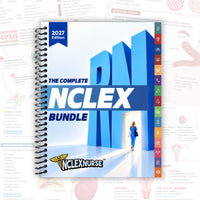
A plan is easier to follow when your core review lives in one place. The Complete NCLEX Bundle from The NCLEX Nurse pairs a 434-page visual hardcover guide for NCLEX-RN and NCLEX-PN with online eBook access and one year of the Guru AI Assistant. The guide covers every system in this plan, from cardiovascular and respiratory to obstetrics, pediatrics, mental health, pharmacology, fluids and electrolytes, safety and prioritization, using charts, tables and memory aids. The AI Assistant can quiz you, break down conditions and medications and walk you through NCLEX-style reasoning when a rationale does not click.
You can also join the MedSchoolGuru NCLEX QBank waitlist. The QBank is coming in January 2027, and guide owners get first access plus a bundle-owner discount.
Frequently Asked Questions
How many hours a day should I study for the NCLEX? There is no official number. Many students aim for roughly 2 to 4 focused hours a day, while those working full time often do 1 to 2 hours on workdays and longer sessions on days off. Steady daily practice matters more than marathon days.
How many practice questions should I do each day? Many students do somewhere around 50 to 100 questions a day, but quality matters more than volume. Read every rationale and note the concept behind each miss.
Should I start studying before I get my ATT? Yes, many candidates do. Your ATT controls when you can schedule, not when you can study. First-time candidates are offered an appointment 30 days after the request to schedule, so starting early gives you a full plan before test day.
Is 4 weeks enough time to study for the NCLEX? It can be for some students, especially recent grads with strong content knowledge. Compress the 8-week plan by combining weeks and focus on the highest-weighted categories and your weakest areas.
How should my study plan change if I failed the NCLEX? Build it around your Candidate Performance Report, starting with areas marked Below the Passing Standard. You can retake 45 days after your exam under NCSBN policy, though your nursing regulatory body may have stricter rules.