
You probably already own more NCLEX material than you can read. There is the review book your program handed out, the one a classmate swore by, a few PDFs from a group chat, and a stack of flashcards from med-surg. And still, when you sit down to study, you are not sure where to start or whether any of it matches what the exam looks like now.
That uncertainty is reasonable. The NCLEX changed in a big way when the Next Generation NCLEX launched on April 1, 2023, and a new RN test plan took effect on April 1, 2026. Plenty of older materials were written for a different exam. If you are studying around shifts, kids, or a previous attempt, you cannot afford to waste weeks on the wrong resource.
This guide walks through what a good guide should include in 2026, how to tell a strong one from a weak one, and how to use it so the material sticks.
What Should a Good NCLEX Study Guide Include?
A good guide in 2026 is aligned to the current 2026 NCLEX-RN Test Plan (effective April 1, 2026 through March 31, 2029), teaches the clinical judgment the Next Generation NCLEX measures, connects each condition from pathophysiology to nursing action, and is organized visually so you can review quickly and then test yourself with questions.
Put more concretely, look for five things:
- Current test plan coverage. All eight Client Needs categories, using the 2026 names, such as "Safety and Infection Prevention and Control."
- Clinical judgment built in. Content that helps you recognize cues, prioritize, and choose actions, not just define terms.
- Connected content. Signs and symptoms, labs, medications, interventions, and patient teaching for a condition on the same page or spread.
- Visual structure. Tables, charts, and memory aids that make comparisons fast.
- A clear pairing with practice questions. A guide teaches; questions test. You need both.
Match the Guide to the 2026 NCLEX-RN Test Plan
The fastest way to judge a guide is to compare its table of contents to the test plan. Here is how the 2026 plan distributes items, and what your guide should help you do in each area.
| Client Needs category | % of items (2026 plan) | What your guide should cover |
|---|---|---|
| Management of Care | 15–21% | Prioritization, delegation, advocacy, legal and ethical practice |
| Safety and Infection Prevention and Control | 10–16% | Fall and injury prevention, isolation precautions, error prevention |
| Health Promotion and Maintenance | 6–12% | Growth and development, prenatal and newborn care, screening |
| Psychosocial Integrity | 6–12% | Therapeutic communication, mental health conditions, crisis care |
| Basic Care and Comfort | 6–12% | Mobility, nutrition, elimination, rest, comfort measures |
| Pharmacological and Parenteral Therapies | 13–19% | Drug classes, key adverse effects, IV therapy, safe administration |
| Reduction of Risk Potential | 9–15% | Lab values, diagnostic tests, procedure complications |
| Physiological Adaptation | 11–17% | Acute and complex illness, fluid and electrolyte imbalance, emergencies |
Why the percentages matter
Management of Care and Pharmacological and Parenteral Therapies are two of the largest categories. A guide that spends 40 pages on rare disorders and five pages on prioritization and pharmacology is out of balance for this exam. Individual exams vary, but your study time should roughly follow these weights.
Check the edition and the language
If a guide still uses older category names, references the pre-2023 exam format, or never mentions clinical judgment or case studies, treat it as a supplement at best. Test plans are updated every three years, so the publication date matters.
Content Review and Clinical Judgment: Your Guide Has to Do Both
What clinical judgment looks like on the exam
The NCSBN Clinical Judgment Measurement Model breaks clinical judgment into six steps: recognize cues, analyze cues, prioritize hypotheses, generate solutions, take action, and evaluate outcomes. A minimum-length NCLEX-RN includes 18 case-study items (three case studies with six items each), plus stand-alone clinical judgment items that make up approximately 10% of the exam.
How to test a guide in five minutes
Open any guide to a common condition, such as heart failure, and ask:
- Does it explain why the symptoms happen, or only list them?
- Can you see which findings are expected and which need immediate action?
- Are the related labs, medications, and nursing interventions on the same spread?
- Does it tell you what to teach the client and which complications to watch for?
If the answer is mostly yes, the guide is teaching you to think like the exam. If you are just reading definitions, you will struggle when a case study asks what you should do next.
Visual beats dense
When you are tired after a 12-hour shift, a well-built comparison table will do more for you than three pages of paragraphs. Look for side-by-side charts (for example, comparing types of shock or insulin categories), clear diagrams, and memory aids that link to the "why."
How to Use Your Guide Without Rereading It Cover to Cover
The best guide in the world will not help if you only read it. Use this loop for each system or topic.
- Start with a short question set. Do 15 to 25 questions on the topic before reading, so you know what you do not know.
- Read the matching section actively. Focus on the pages tied to the questions you missed. Pause after each condition and say out loud what you would assess first and what you would do.
- Condense it. Write a one-page summary per system: key findings, priority actions, high-risk meds, and teaching points.
- Test the same day. Do another question set on that topic within a few hours of reading.
- Loop missed questions back to the guide. For each miss, find the page that explains it and add one line to your summary.
- Mix it up weekly. Once a week, do a mixed set across everything you have covered so far.
For how to fit this loop into a weekly calendar, see our NCLEX study plan, and for choosing and working through question sets, read our guide to NCLEX practice questions.
Print, eBook, or Both?
When print helps
Many students remember information better on paper, especially tables and diagrams they can flip back to. A hardcover guide also gives you a single home base instead of 40 open tabs.
When digital helps
An eBook lets you review on your phone during a lunch break, in a waiting room, or on a commute. If your study time comes in 15-minute pieces, that flexibility adds up.
Using AI tools wisely
AI study assistants can explain a topic another way, quiz you, and answer follow-up questions. Use them to deepen understanding, and cross-check anything that does not match your guide or current nursing references.
What Most Students Get Wrong About Choosing an NCLEX Study Guide
Buying three guides and finishing none
Switching resources feels like progress. In reality, one well-used guide plus a steady stream of practice questions usually beats a shelf of half-read books.
Treating the guide like a novel
Reading page one to page 400 without questions in between leads to recognition, not recall. The exam asks you to apply information, so practice applying it as you go.
Using an outdated edition
Older materials may be fine for anatomy, but they can miss the 2026 test plan categories and the clinical judgment focus. Check the date before you commit your weeks to it.
Highlighting everything
If every line is yellow, nothing stands out. Write your own short summary instead.
Skipping the "boring" sections
Safety, infection control, delegation, and prioritization feel less exciting than cardiac, but together they make up a large share of the exam.
A Study Guide Built Around How the NCLEX Thinks
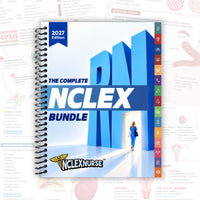
If you want one resource to anchor your review, The Complete NCLEX Bundle from The NCLEX Nurse was built for this exam. It includes a 434-page visual hardcover study guide for NCLEX-RN and NCLEX-PN, full of charts, illustrations, structured tables, and memory aids that connect signs and symptoms, pathophysiology, diagnostics, lab values, pharmacology, nursing interventions, patient education, prioritization, delegation, safety, and complications. It covers every major system plus obstetrics, pediatrics, mental health, fluids and electrolytes, and fundamentals. You also get online eBook access for your computer, tablet, or phone, and one year of the Guru AI Assistant with unlimited prompts to explain topics, compare diagnoses, and quiz you. The hardcover is on pre-order and ships late November; the eBook-only version is available instantly.
To pair the guide with a question bank later, join the MedSchoolGuru NCLEX QBank waitlist. It is coming in January 2027, and guide owners get first access and a bundle-owner discount.
Frequently Asked Questions
Is one NCLEX study guide enough? For most students, one comprehensive, current guide plus regular practice questions is enough. Add a second resource only to fill a specific gap your question results reveal.
Should I use a study guide or a question bank? Use both. The guide builds and organizes your knowledge, and questions show whether you can apply it under exam conditions. Many students go back and forth daily.
How long does it take to get through a full study guide? It depends on your schedule and how much content you need to rebuild. Many students work through a full guide over several weeks by covering one or two systems at a time alongside questions.
Does the 2026 test plan change what I need in a guide? The 2026 NCLEX-RN Test Plan runs through March 31, 2029 and uses the category name Safety and Infection Prevention and Control, so check that your guide matches the current plan's wording. A guide that reflects the current plan and clinical judgment focus will match the exam more closely.
Can I use an NCLEX-PN guide for the RN exam? Use a guide that covers the NCLEX-RN. Some guides, including The NCLEX Nurse study guide, cover both RN and PN, but always study against the RN test plan if that is your exam.